
Tax forms every business needs for hiring contractors
Looking at hiring contractors but you aren’t sure what you need? Check out our breakdown of tax forms every business needs for hiring contractors.


The last several years have seen a drastic spike in the number of businesses hiring independent contractors. This rush to bring in freelance labor, however, carries the risk of misclassification — incorrectly classifying your new workers as contractors or employees when they are, in fact, the other — which carries significant penalties.
Business owners navigating these waters need to make sure they are filing the correct forms. However, this becomes significantly more difficult as you dive deeper into the weeds. That’s why we made the flowchart presented here; the remainder of this article breaks it down further and explains what tax forms every business needs for hiring contractors.
Tax forms every business needs for hiring contractors in the US
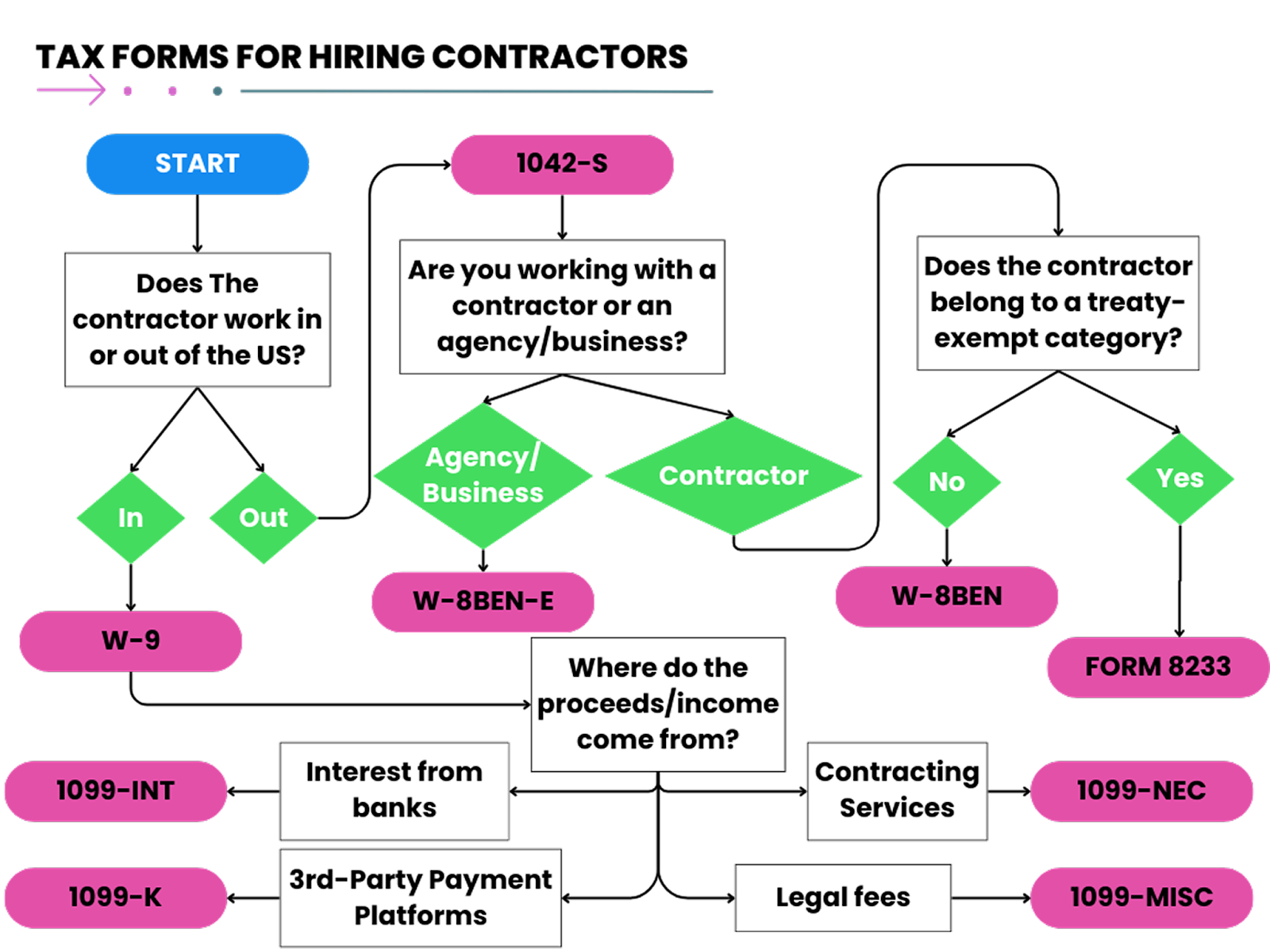
A contractor’s operating location is the first of several considerations when determining what tax forms you will need for them. All U.S.-based contractors will require a W-9 form and some form of 1099.
Tax Forms Every Business Needs for Hiring Contractors in the US
| Contractor Type | Forms to Collect | Forms to Issue | IRS Filing |
|---|---|---|---|
| US Contractor | W-9 | 1099 (relevant variant) | 1096 (paper only) |
To collect: W-9
A W-9 form is collected by the company at or before the time of hire, but it should be collected at least by the time of the first payment. This form certifies the contractor’s Taxpayer Identification Number (TIN) or Social Security Number (SSN).
W-9 collection typically follows a standard procedure:
- The employer sends a digital PDF for the contractor to fill out or has them fill out a physical copy
- The contractor sends the filled copy to the employer
- The employer and contractor keep a copy in their records
W-9s do NOT need to be filed with the IRS; simply keep a copy handy in the event of an audit.
To issue: 1099
Form 1099 is the company’s account of all income made from independent contracting services. The most commonly used form for independent contractors is the 1099-NEC. However, there are several variants of Form 1099, a few of which may also apply:
Common 1099 variants for independent contractors
| 1099 Form | Purpose |
|---|---|
| Form 1099-NEC | Payments to independent contractors (the primary form for 1099 workers) |
| Form 1099-MISC | Miscellaneous income (e.g., rent, prizes, royalties) |
| Form 1099-K | Payments received via third-party platforms |
| Form 1099-INT | Interest income (from banks, etc.) |
These forms need to be issued to both the IRS and the contractor prior to January 31, assuming they have made more than $600.
To file with the IRS: Form 1096
Tax Form 1096 is an account of the total 1099s being submitted in a fiscal year, including the total amount paid and the total number of forms. It essentially functions as a kind of cover sheet for the IRS, but it is only necessary when submitting paper 1099s; if you plan on e-filing, the 1096 is not necessary.
If you plan on using a 1096, submit it with COPY A of all 1099 forms included on the 1096 by January 31. The address to submit varies depending on where your business is located; use the IRS guide “Where to file Form 1096” to determine the correct location.
Tax forms every business needs for hiring contractors internationally
Cross-border hiring carries with it an entirely different set of forms in order to prevent misclassification. Contrary to domestic hiring, where the form being issued has a large number of variants, however, international hiring places a larger focus on the form being collected from the contractor.
Tax forms every business needs for hiring contractors internationally
| Contractor Type | Forms to Collect | Forms to Issue | IRS Filing |
|---|---|---|---|
| Foreign (Individual) | W-8BEN | 1042-S | 1042, 945 |
| Foreign (Qualifying Individual) | W-8BEN, 8223 | 1042-S | 1042, 945 |
| Foreign (Agency) | W-8BEN-E | 1042-S | 1042, 945 |
To collect: W-8BEN
The W-8BEN is the standard form to collect when hiring international contractors. Mirroring the domestically oriented W-9, the W-8BEN certifies that the contractor is a foreign person, documenting relevant tax identification and claim of treaty benefits.
There is one variant of the W-8BEN, the W-8BEN-E, which is used in the event that the foreign entity being contracted is an agency or business operating in another country.
International contractor tax forms based on the mode of partnership
| Individual | Agency/Business |
|---|---|
| W-8BEN | W-8BEN-E |
In certain circumstances, foreign individuals may find themselves doing work within the United States. Until those individuals meet the requirements for the “Substantial Presence Test”, they may qualify for additional tax exemptions using Form 8233 up to 30% of their income. The standards to qualify for Form 8233 include:
- Have been in the country for >183 days
- Are foreign nationals
- Are working within the United States
Once the contractor meets these standards, they must switch to a W-9. Form 8233 must be submitted by the contractor to the employer along with their W-8BEN, who then sends the form to the IRS within 5 days of receipt (W-8BENs are not sent to the IRS, but the employer keeps a copy for their records).
To issue: Form 1042-S
Form 1042-S acts as the international equivalent of the 1099-NEC for international contractors. These forms document the amount paid, tax withheld, income code, as well as the country of residence. Unlike the 1099-NEC, however, the 1042-S is a singular document with no variants, making this aspect of international hiring significantly easier.
1042-Ss must be filed by March 15 with the IRS.
To file with the IRS: Form 1042
Similar to Form 1096 for domestic contractors, Form 1042 acts as the summary cover sheet for all 1042-Ss filed by the employer within the last year, including:
- Total income
- Amount of tax withheld
- Total number of forms filed
These forms are filed by March 15 with the IRS.
To file with the IRS: Form 945
Form 945 is filed by the employer directly to the IRS to report federal income tax withheld from non-employees. This includes backup and withholding, as long as it has been paid to the IRS over the course of the year.
Form 945 must be filed by January 31 directly with the IRS.
Is there an easier way to do this?
As this article hopefully illuminates, navigating the tax forms every business needs for hiring contractors is difficult. More so, the price paid for misclassification is steep – several countries even take IP ownership into account when determining penalties for failure to file or misfiling, meaning that employers stand to lose control over work that they have already paid for.
This is precisely why so many businesses choose to work with an agent-of-record (AOR) provider like Payoneer Workforce Management. We help you handle the time-consuming granular work, reducing misclassification errors so that your operations are able to grow smoothly.
FAQs
1) What about foreign nationals living in the US or US citizens working abroad?
Citizenship plays a critical role in determining what tax forms businesses need for hiring contractors, and it gets especially tricky when evaluating that against where they live and how long they’ve lived there.
Foreign nationals, for example, who have lived within the US for 183+ days have met the “Substantial Presence Test”, assuming those 183 days fall into one of the three following categories:
- 100% of days in the current year
- 33% of days last year
- 18.5% of days the year before
In these cases, that foreign national would be issued a W-9 instead of the usual W-8BEN. The following table breaks this down a bit more clearly:
Tax forms for hiring contractors based on location & citizenship status
| Contractor Type | SPT Met? | Location | Form to Collect |
|---|---|---|---|
| US Citizen | N/A | Anywhere | W-9 |
| Green Card Holder | N/A | Anywhere | W-9 |
| Foreign National | Yes | Inside US | W-9 |
| Foreign National | No | Inside US | W-8BEN |
| Foreign National | N/A | Outside US | W-8BEN |
2) What about the other forms of 1099s?
Form 1099 has several variants beyond the four discussed in the section above. The table below lists each, including why they typically do not apply for hiring contractors.
| 1099 Form | Why They Don’t Apply |
|---|---|
| 1099-DIV | Reports dividends and distributions |
| 1099-B | Reports income from broker or barter exchanges (stocks, trades) |
| 1099-R | Reports retirement account distributions |
| 1099-G | Reports government payments (e.g., unemployment compensation) |
| 1099-C | Reports canceled debts |
| 1099-Q | Reports distributions from education savings accounts |
| 1099-S | Reports proceeds from real estate transactions |
3) Do I need to file multiple 1099s?
The answer here is complicated. The short answer is “It’s possible, but probably not.”
A separate 1099 will need to be filed for each individual contract signed with a client. That means that it’s entirely possible to fill out multiple 1099s, even with the same client, for separate jobs worked. It gets more complicated.
This aspect of 1099s gets confusing; a helpful way to think of it is with two filters:
| Filter # | 1099 Variant | ||
|---|---|---|---|
| 1. What is the payment being given for? | Contractor Services | Rents, Royalties, Prizes | Interest |
| (NEC) | (MISC) | (INT) | |
| 2. Was I paid directly or via a third party? | Direct – Check, Transfer | 3rd-Party | Brokerage/Wallet |
| (Use form from Filter 1) | (K) | (DIV/INT) |
The confusion around 1099 management is one of the primary reasons businesses consider working with contractor management tools like Payoneer Workforce Management; these platforms provide business owners with the tools they need to easily and efficiently classify independent contractors appropriately to minimize misclassification risks and get operations moving.
4) What if I’m not sure if the worker is actually a contractor?
If your worker falls into the “employee” designation, you’ll need to file a form W-2 instead of a W-9. The line between contractors and employees is remarkably thin, but you can use provided guides like the IRS 20-point checklist to narrow down your evaluation.
If you are still unsure, however, you can also file a Form SS-8 to request an IRS determination of worker status.
5) Do contractors get 1099-MISC or 1099-NEC?
Contractors typically receive a 1099-NEC for non-employee compensation. The 1099-MISC is used for other types of payments, like rent or legal settlements, not for standard contractor work.
6) Do I need an EIN if I hire independent contractors?
You don’t always need an EIN, but it’s recommended. If you’re filing 1099 forms with the IRS, especially as a business, having an EIN simplifies the process and keeps your personal information private.
7) Do contractors fill out a W-9 or a 1099?
Contractors fill out a W-9 to provide their taxpayer information to the hiring company. The company then uses that information to issue a 1099-NEC if the contractor is paid $600 or more during the year.
Hire & pay globally with Payoneer Workforce Management
- Expand internationally in 160+ countries
- Run global payroll securely in a few clicks
- Stay compliant with local employment laws
- Let Payoneer Workforce Management manage benefits, work permits, timesheets, and more so you don’t have to


Schedule a demo
Related resources

Leave policy in Costa Rica
A detailed look at annual leave, public holidays, maternity leave, paternity leave, and sick leave entitlements in Costa Rica, and how EOR can simplify them.


Leave policy in Romania
Understand employee leave policy in Romania, including annual leave in Romania, maternity, paternity, and sick leave, and learn how to manage teams compliantly.

Planning to hire employees in Belgium? Here’s a quick guide
Learn how to engage employees in Belgium. Explore working hours, payroll, leave policies, taxes, compliance requirements, and the essentials of the hiring process.

Leave policy in China
A simple guide to leave policies in China, including annual leave, sick leave, maternity leave, paternity leave, public holidays, and other statutory leave entitlements.

Employment laws in Denmark
Understand employment laws in Denmark, including working hours, leave, termination rules, and compliance tips for hiring.
Your guide to payroll in Denmark
A detailed look at Denmark payroll, including pay cycles, salary tax in Denmark, employer taxes, deductions, and payroll compliance. Explore tips for payroll management in Denmark.

Leave policy in Portugal
Learn about the different leave policies entitled to the Portuguese workforce, along with complete compliance with Payoneer Workforce Management.

Leave policy in Vietnam
Learn about leave policies in Vietnam. This guide covers sick days, maternity leave, and public holidays in Vietnam
Planning to hire employees in Denmark? Here’s a quick guide
Learn about employment regulations in Denmark, tax obligations, leave policies, and how Payoneer Workforce Management helps you engage talent compliantly.
Latest articles
-

Leave policy in Costa Rica
A detailed look at annual leave, public holidays, maternity leave, paternity leave, and sick leave entitlements in Costa Rica, and how EOR can simplify them.
-
Leave policy in Romania
Understand employee leave policy in Romania, including annual leave in Romania, maternity, paternity, and sick leave, and learn how to manage teams compliantly.
-
Planning to hire employees in Belgium? Here’s a quick guide
Learn how to engage employees in Belgium. Explore working hours, payroll, leave policies, taxes, compliance requirements, and the essentials of the hiring process.
-
How New Game Studios in the Philippines Manage Revenue Across Global Platforms
This guide explores how game studio CEOs and founders can utilize fragmented income streams from Steam, App Stores, ad networks, and more, while mitigating FX volatility and legacy banking lags.
-
Leave policy in China
A simple guide to leave policies in China, including annual leave, sick leave, maternity leave, paternity leave, public holidays, and other statutory leave entitlements.
-
Employment laws in Denmark
Understand employment laws in Denmark, including working hours, leave, termination rules, and compliance tips for hiring.






Disclaimer
The information in this article/on this page is intended for marketing and informational purposes only and does not constitute legal, financial, tax, or professional advice in any context. Payoneer and Payoneer Workforce Management are not liable for the accuracy, completeness or reliability of the information provided herein. Any opinions expressed are those of the individual author and may not reflect the views of Payoneer or Payoneer Workforce Management. All representations and warranties regarding the information presented are disclaimed. The information in this article/on this page reflects the details available at the time of publication. For the most up-to-date information, please consult a Payoneer and/or Payoneer Workforce Management representative or account executive.
Availability of cards and other products is subject to customer’s eligibility. Not all products are available in all jurisdictions in the same manner. Nothing herein should be understood as solicitation outside the jurisdiction where Payoneer Inc. or its affiliates is licensed to engage in payment services, unless permitted by applicable laws. Depending on or your eligibility, you may be offered the Corporate Purchasing Mastercard, issued by First Century Bank, N.A., under a license by Mastercard® and provided to you by Payoneer Inc., or the Payoneer Business Premium Debit Mastercard®, issued and provided from Ireland by Payoneer Europe Limited under a license by Mastercard®.
Skuad Pte Limited (a Payoneer group company) and its affiliates & subsidiaries provide EoR, AoR, and contractor management services.
